A Ten-Minute Slot, One Clear Message
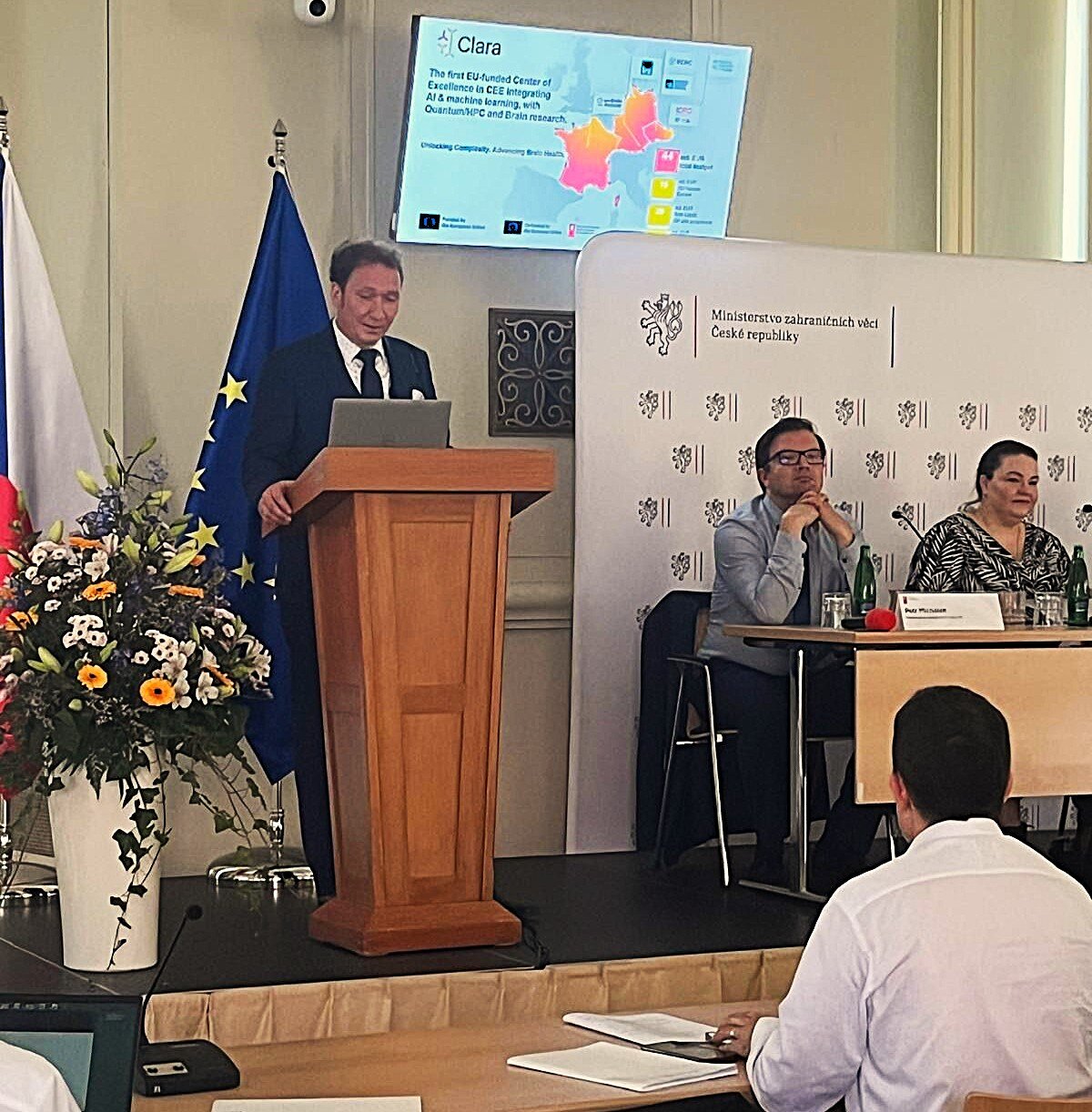
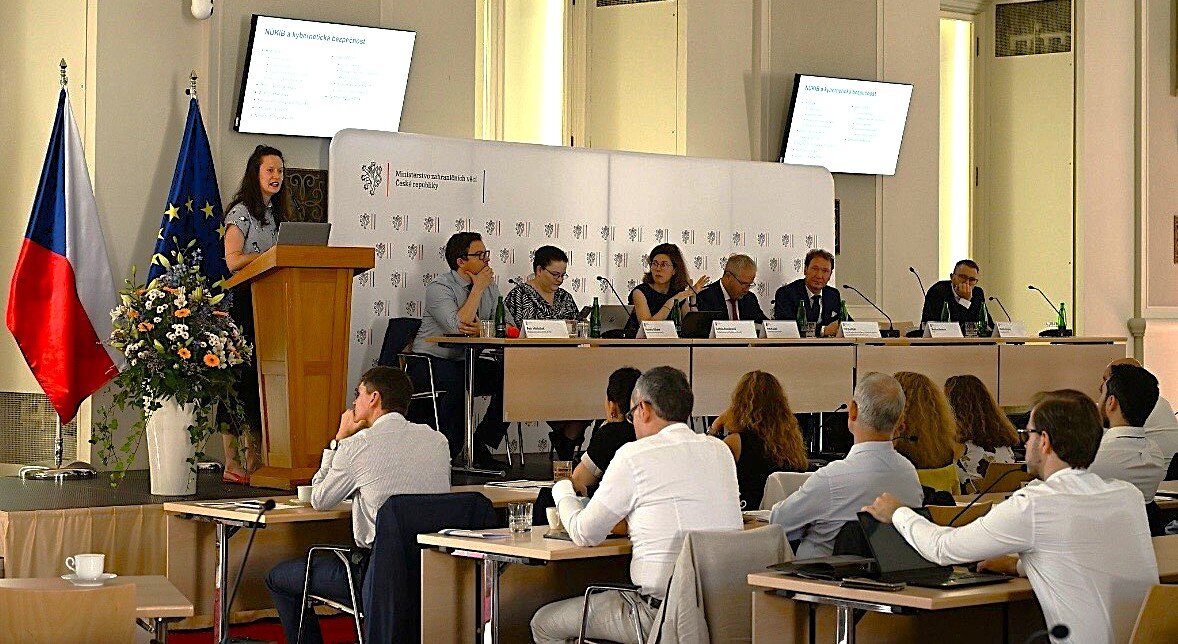
The AI/quantum/cyber roundtable ran four times over the course of the day to accommodate the number of diplomats interested, with each session covering artificial intelligence, quantum technologies, cybersecurity, and concrete applications of AI and quantum computing. Dr. Vít Dočkal spoke in the fourth category, alongside representatives of the Czech National AI Platform, the Ministry of Industry and Trade, national quantum-technology experts, the CyberSecurity Hub and the National Cyber and Information Security Agency (NÚKIB).
Within his ten-minute presentation, Dr. Vít Dočkal introduced the diplomats to:
- CLARA - the Center for Artificial Intelligence and Quantum Computing in System Brain Research, an interdisciplinary center of excellence, the first of its kind in Central and Eastern Europe, which applies AI, machine learning and quantum-accelerated high-performance computing to neurodegeneration research, with a particular focus on Alzheimer's disease, and which is coordinated by INDRC from Prague, Czech Republic.
- CZAI: Czech AI Factory, the national initiative in which INDRC and CLARA participate to strengthen the Czech Republic's AI computing infrastructure.
Introducing the CLARA–NANO Pilot
The centerpiece of Dr. Vít Dočkal's presentation was NANO-CLARA, a new environmental-health pilot extending CLARA's mission beyond the clinic and into everyday exposure risk. The project focuses on two of the most common but least understood sources of urban pollution: brake-wear nanoparticles and tire-derived nanoplastics, both released continuously by road traffic regardless of whether vehicles are electric or combustion-powered.
Rather than assuming a link between these particles and Alzheimer's disease, NANO-CLARA is designed to rigorously test that link. The pilot combines particle characterization, controlled biological models, multimodal molecular and imaging readouts, and CLARA's topology-aware visual analytics to map how source-specific particles interact with the blood-brain barrier, neuroinflammation, oxidative stress, immune regulation, and amyloid/tau biology — the biological processes most closely tied to cognitive decline. The goal at this stage is not to determine long-term human risk, but to build a reproducible, hypothesis-generating infrastructure that can be credibly scaled to cohort studies and policy-relevant research.
By the end of the pilot, the project is expected to deliver a source-specific Particle Atlas for brake and tire particles, a FAIR multimodal particle-health data resource, a perturbation-response matrix across biological models, a topology-aware visualization pipeline, and a set of prioritized, cross-validated hypotheses ready for clinical and cohort follow-up.
Why It Resonated
The Czech Republic's network of embassies reaches directly into the research, funding and innovation ecosystems of dozens of territories around the world — exactly the kind of access a pilot project like NANO-CLARA needs as it looks for its more international partners. Presenting the project to more than a hundred diplomats in a single day was, in that sense, one of the most efficient outreach opportunities CLARA has had since the pilot's launch.
INDRC and CLARA thank the Ministry of Foreign Affairs' Department of Economic and Science Diplomacy, and in particular the Science Diplomacy Unit, for the invitation, and look forward to following up with individual embassies on concrete opportunities for cooperation on NANO-CLARA and CLARA's wider research agenda.
Photo Credit: INDRC, Ministry of Foreign Affairs' Department of Economic